Back to All Blueprints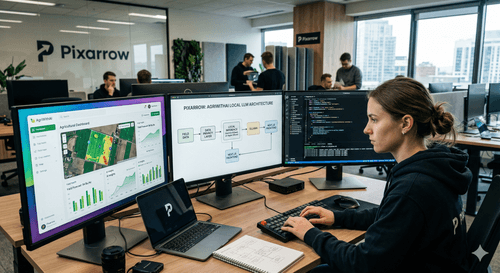
Development
April 12, 2026
•5 min read
Beyond the Landing Page: Engineering High-Performance AI Web Apps for Early-Stage Disruptors
Most agency-built MVPs crumble under scale. In this technical deep-dive, we reveal how Pixarrow bypassed expensive cloud APIs to engineer a secure, high-performance web app for an early-stage AI startup. Discover how deploying local LLMs (Gemma 4 & Qwen) on Apple Silicon combined with a custom Next.js frontend delivers enterprise-grade data privacy, zero API costs, and a fluid, high-converting user experience.
P
Pixarrow Team
Senior Architecture Lead
Verified Blueprint
Most agency-built MVPs are glorified wireframes stitched together with bloated third-party APIs. They look great in a pitch deck but crumble the second you hit 1,000 concurrent users. At Pixarrow, we don't build disposable prototypes; we engineer scalable foundations.
Recently, we architected the MVP for AgriWithAI, a smart agricultural tech platform. The founders had a strict mandate: deliver a premium, high-speed UI while ensuring complete data sovereignty for their users' proprietary yield data. Relying on standard OpenAI calls wasn't going to cut it. We needed enterprise-grade privacy with startup-level velocity.
Here is exactly how we bypassed the cloud bottleneck by deploying localized LLMs (Gemma 4 and Qwen) on Apple Silicon, bridged seamlessly to a Next.js frontend.
Step 1: The Cloud API Bottleneck
When evaluating the architecture for AgriWithAI, the immediate reflex was to plug into a cloud LLM provider. However, an engineer-to-engineer breakdown revealed three critical dealbreakers for an early-stage disruptor:
Data Sovereignty: Agricultural data is highly sensitive. Routing proprietary farm metrics through third-party servers introduced unacceptable compliance risks.
Latency: Rural users often deal with degraded network conditions. Adding an average 800ms-1200ms round-trip time for a cloud API call would ruin the user experience.
Variable OpEx: For a bootstrapped or seed-stage startup, unpredictable token costs can destroy a runway.
The Pivot: We decided to shift inference to the edge, utilizing local hardware to eliminate token costs and guarantee zero data leakage.
Step 2: Optimizing Local Inference on Apple Silicon
To achieve cloud-level intelligence locally, we leveraged the unified memory architecture of Apple Silicon (M-series chips). This allowed us to load large model weights directly into memory without the VRAM bottlenecks of traditional GPU setups.
We benchmarked several models before settling on a quantized pipeline using Ollama to serve Gemma 4 and Qwen.
Quantization Strategy: We used 4-bit quantization (GGUF format) to compress the model weights. This reduced the memory footprint by over 60%, allowing the models to run blisteringly fast without a noticeable drop in reasoning quality.
The Setup: Running Ollama as a local service provided a clean REST API interface right on the host machine.
Bash
# Pulling and serving the optimized model locally via Ollama
ollama run gemma:4b-instruct-q4_K_M
This stack resulted in a flat $0 monthly API bill for inference, with sub-200ms Time To First Token (TTFT).
Step 3: Bridging the Gap with a Next.js Frontend
A powerful backend is useless if the UI feels sluggish. Pixarrow specializes in premium design, so the integration needed to be flawless. We built a custom Next.js (React) frontend to interface with our local Ollama server.
To maintain the illusion of instant processing, we utilized Server-Sent Events (SSE) to stream the LLM outputs directly to the UI.
JavaScript
// Next.js API Route (App Router) for streaming local LLM response
export async function POST(req) {
const { prompt } = await req.json();
const response = await fetch('http://localhost:11434/api/generate', {
method: 'POST',
headers: { 'Content-Type': 'application/json' },
body: JSON.stringify({
model: 'gemma:4b',
prompt: prompt,
stream: true,
}),
});
return new Response(response.body, {
headers: { 'Content-Type': 'text/event-stream' },
});
}
The Result: A seamless, premium interface where AI insights render word-by-word in real-time. The user gets a fluid, high-converting UX, and the founders get a secure, scalable app infrastructure.
The ROI of Full-Cycle Engineering
Startups often try to save money by separating their design and engineering teams. The result is "design debt"—beautiful interfaces paired with fragile, unscalable code.
By handling both the premium UI/UX and the hardcore engineering (like local LLM deployment), Pixarrow delivered an MVP for AgriWithAI that is ready for Series A due diligence on day one. We bypassed the cloud, secured the data, and built a web app that actually performs.
Stop paying for disposable code. If you are building a high-stakes MVP and need a technical partner who understands both pixel-perfect design and backend scalability, let's talk architecture.
Recently, we architected the MVP for AgriWithAI, a smart agricultural tech platform. The founders had a strict mandate: deliver a premium, high-speed UI while ensuring complete data sovereignty for their users' proprietary yield data. Relying on standard OpenAI calls wasn't going to cut it. We needed enterprise-grade privacy with startup-level velocity.
Here is exactly how we bypassed the cloud bottleneck by deploying localized LLMs (Gemma 4 and Qwen) on Apple Silicon, bridged seamlessly to a Next.js frontend.
Step 1: The Cloud API Bottleneck
When evaluating the architecture for AgriWithAI, the immediate reflex was to plug into a cloud LLM provider. However, an engineer-to-engineer breakdown revealed three critical dealbreakers for an early-stage disruptor:
Data Sovereignty: Agricultural data is highly sensitive. Routing proprietary farm metrics through third-party servers introduced unacceptable compliance risks.
Latency: Rural users often deal with degraded network conditions. Adding an average 800ms-1200ms round-trip time for a cloud API call would ruin the user experience.
Variable OpEx: For a bootstrapped or seed-stage startup, unpredictable token costs can destroy a runway.
The Pivot: We decided to shift inference to the edge, utilizing local hardware to eliminate token costs and guarantee zero data leakage.
Step 2: Optimizing Local Inference on Apple Silicon
To achieve cloud-level intelligence locally, we leveraged the unified memory architecture of Apple Silicon (M-series chips). This allowed us to load large model weights directly into memory without the VRAM bottlenecks of traditional GPU setups.
We benchmarked several models before settling on a quantized pipeline using Ollama to serve Gemma 4 and Qwen.
Quantization Strategy: We used 4-bit quantization (GGUF format) to compress the model weights. This reduced the memory footprint by over 60%, allowing the models to run blisteringly fast without a noticeable drop in reasoning quality.
The Setup: Running Ollama as a local service provided a clean REST API interface right on the host machine.
Bash
# Pulling and serving the optimized model locally via Ollama
ollama run gemma:4b-instruct-q4_K_M
This stack resulted in a flat $0 monthly API bill for inference, with sub-200ms Time To First Token (TTFT).
Step 3: Bridging the Gap with a Next.js Frontend
A powerful backend is useless if the UI feels sluggish. Pixarrow specializes in premium design, so the integration needed to be flawless. We built a custom Next.js (React) frontend to interface with our local Ollama server.
To maintain the illusion of instant processing, we utilized Server-Sent Events (SSE) to stream the LLM outputs directly to the UI.
JavaScript
// Next.js API Route (App Router) for streaming local LLM response
export async function POST(req) {
const { prompt } = await req.json();
const response = await fetch('http://localhost:11434/api/generate', {
method: 'POST',
headers: { 'Content-Type': 'application/json' },
body: JSON.stringify({
model: 'gemma:4b',
prompt: prompt,
stream: true,
}),
});
return new Response(response.body, {
headers: { 'Content-Type': 'text/event-stream' },
});
}
The Result: A seamless, premium interface where AI insights render word-by-word in real-time. The user gets a fluid, high-converting UX, and the founders get a secure, scalable app infrastructure.
The ROI of Full-Cycle Engineering
Startups often try to save money by separating their design and engineering teams. The result is "design debt"—beautiful interfaces paired with fragile, unscalable code.
By handling both the premium UI/UX and the hardcore engineering (like local LLM deployment), Pixarrow delivered an MVP for AgriWithAI that is ready for Series A due diligence on day one. We bypassed the cloud, secured the data, and built a web app that actually performs.
Stop paying for disposable code. If you are building a high-stakes MVP and need a technical partner who understands both pixel-perfect design and backend scalability, let's talk architecture.
Scale With Pixarrow
Ready to Implement This Architecture?
Book a 30-minute strategy call with our engineering partners or estimate your project cost in 2 minutes.